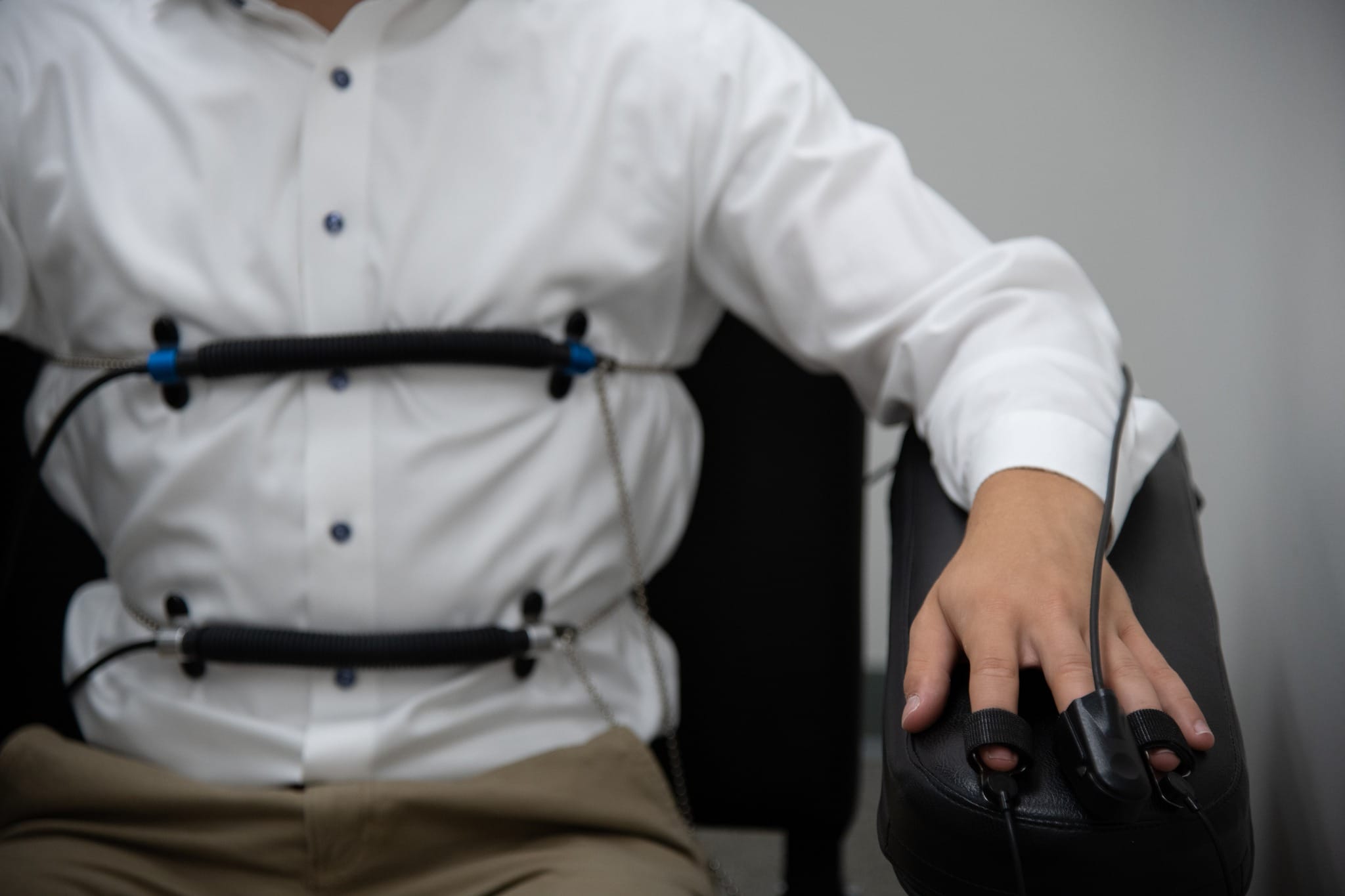
A LAFAYETTE COMPANY, BUILT ON POLYGRAPHS, IS NOW A GLOBAL FORCE IN BRAIN SCIENCE
Lafayette Instrument, a 79-year-old manufacturer, has assembled a neuroscience equipment empire, and it's latest deal may be it's most consequential
By Shelby White
May 14, 2026
The polygraph reads the body’s involuntary confessions, the quickened pulse, the shallow breath, the skin that conducts electricity differently under the pressure of a lie.
It does not know the truth. It knows only that something is happening, and leaves the interpretation to the examiner sitting across the table. In this way, it is less a lie detector than a conversation starter, an instrument that makes the invisible legible, however imperfectly.
Lafayette Instrument Co. has been making them for nearly 80 years, in a low-slung building on Sagamore Parkway familiar to most people in Greater Lafayette, Indiana.
The company has been changing for years. On Monday, Lafayette Instrument announced that it had acquired Sutter Instrument Corp., a Novato, California firm that has spent 50 years making precision tools for electrophysiology, the study of electrical activity in biological cells. The deal, backed by New York private equity firm Branford Castle Partners, was the fifth acquisition Lafayette Instrument has completed since 2021.
The acquisition puts the Lafayette-based company at the center of one of the fastest-growing segments in global science. The neuroscience instrumentation market is valued at more than $40 billion in 2026 and is projected to reach $55 billion by 2031. Instruments account for the largest share of that market.
The researchers who use them, at universities and pharmaceutical companies worldwide, are chasing Alzheimer’s treatments, Parkinson’s therapies and the next generation of brain-computer interfaces. They need equipment that works, reliably, at the level of a single cell. That is what Sutter has made for half a century. It is now what a Lafayette-based company sells.
The deal comes as consolidation accelerates across the fragmented market for specialized laboratory instruments, with private equity sponsors moving to acquire niche suppliers drawn by recurring revenue and the near-impossibility of replicating what long-tenured instrument makers know.
Greater Lafayette has spent years cultivating the conditions that make this kind of growth possible, such as a Purdue Universitypipeline producing engineers and researchers, a manufacturing base with deep technical roots and an economic identity that has been expanding beyond agriculture and automotive supply chains. A homegrown company extending its reach into global neuroscience research is exactly the kind of story the region has been building toward.
“Lafayette Instrument just kept getting better at precision scientific manufacturing, and the world caught up,” said Mikel Berger, president and chief executive at Greater Lafayette Commerce. “A company like this — one that’s growing, that’s acquiring, that’s shipping instruments to research labs in Tokyo and Amsterdam — changes what’s possible for everyone around it.”
Purdue Research Park, located four minutes from the university’s main campus, is home to more than 100 technology-based companies and is the largest university-affiliated research park in the United States. That ecosystem — talent pipelines, wet lab space, proximity to research faculty — has made the Greater Lafayette region increasingly attractive to life sciences companies in particular.
The through line, if you look for it, is not hard to find. Lafayette Instrument has always been in the business of understanding what the nervous system is doing. The instruments Sutter makes go considerably further in — probing the electrical signals of individual neurons under laboratory conditions. The company that once asked whether you were lying is now helping researchers ask what, precisely, a brain cell does when it fires.
Chief executive Benjamin Mangrich pointed to Sutter’s half-century of presence in cellular research as evidence of a strong fit. “Sutter Instrument has been a global leader in instrumentation supporting cellular research and electrophysiology for over 50 years,” Mangrich said. “The company’s strong product portfolio, deep technical expertise and commitment to customer success make them a natural complement to Lafayette Instrument’s Life Science portfolio.”
Branford Castle managing director Ceon Francis described the deal as enhancing Lafayette Instrument’s ability to serve life sciences customers who demand the most current tools.
“This acquisition strengthens Lafayette's platform and broadens its product offering,” said Francis. “We are excited to collaborate with management as we continue to build on the company's momentum and drive long-term growth."
Financial terms of the transaction included senior debt financing from Byline Bank and mezzanine debt from Brookside Capital Partners. Branford Castle was advised by Akerman LLP and RSM, while Sutter was represented by EC M&A and Donahue Fitzgerald LLP. Other terms were not disclosed.
For a company like Lafayette Instrument, the strategy is working because the foundation was already there, including decades of technical credibility and a city with a world-class research university at its center.
It started with a lie. Now it’s helping scientists pursue a different kind of truth.