GREATER LAFAYETTE HAS 35,000 MANUFACTURING WORKERS. IT NEEDS MORE.
As reshoring drives demand for skilled production workers across the country, one Indiana region has spent a decade building the pipeline. The question now is whether it's big enough
By Shelby White | Photos by Jennifer Boss
May 7, 2026
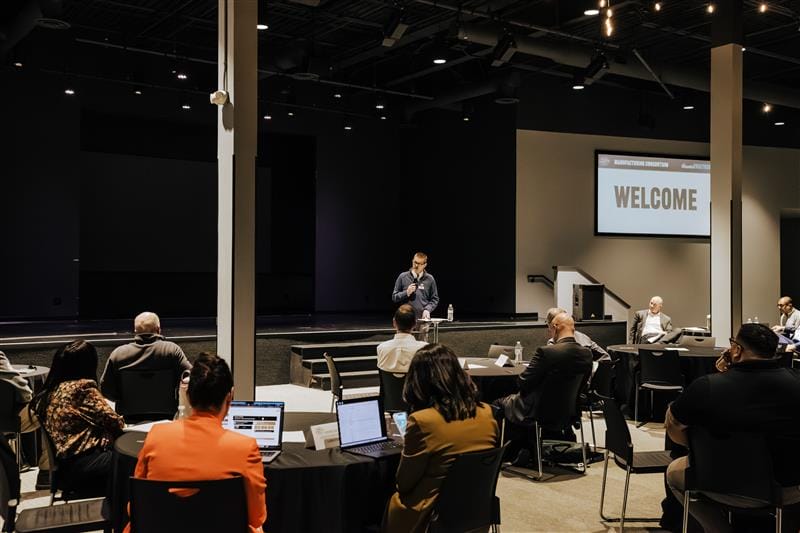
Todd Wetli has worked at Evonik’s Lafayette plant long enough to remember when finding a qualified line worker was a manageable problem. It isn’t anymore. Wetli, the site’s vice president and manager, told a room of about regional manufacturers this week that the challenge has outgrown what any single company can solve internally.
“We’re used to figuring things out inside our own facilities, with our own teams,” he said. “The fact that you’re here today shows we can’t do that anymore.”
On May 4, Greater Lafayette Commerce hosted its inaugural Manufacturing Consortium, a working session built around a problem every company in the room knows well.
Greater Lafayette is not the only region facing these challenges. It may be one of the few with answers. Nationally, nearly 450,000 manufacturing jobs sat unfilled as of last spring, according to Federal Reserve data. Reshoring and foreign direct investment added 244,000 more announced positions in 2024 alone.
The Manufacturing Institute projects a national shortfall of 1.9 million manufacturing workers by 2033. And in a 2025 survey, U.S. manufacturers said a stronger skilled workforce would bring back more domestic production than tariffs, a weaker dollar, lower tax rates, or corporate tax cuts by a significant margin. Workforce is the constraint. Greater Lafayette has been working on that constraint, with some seriousness, for a decade.
The region’s manufacturing base is sizable. Approximately 35,500 workers across the eight-county area, 18,800 in Tippecanoe County alone, earning an average annual wage just over $51,000.
The employer roster runs from the anchors that defined the region’s industrial identity — Caterpillar, which arrived in 1982; Wabash National, founded here in 1985; Subaru of Indiana Automotive, Indiana’s first transplant auto assembly plant, which opened in 1989 — to a newer cohort that signals a different kind of ask: Saab, GE Aviation, Rolls-Royce and SK Hynix, the South Korean semiconductor company whose presence in the region demands credentials the local workforce is still being trained to hold.
None of the anchors were easy fits when they arrived. Caterpillar needed precision diesel engine production at a scale the region had never attempted. Subaru needed workers who had never built a car. The response, each time, was the same: Ivy Tech built programs, Purdue built pipelines, employers came to the table and workers showed up ready. The region has been asked to repeat that pattern, with higher technical stakes, in a labor market that is tighter than anything those earlier transitions faced.
The infrastructure built to meet the challenge is more extensive than it looks from the outside. Career+, the organization’s K-12 workforce program, connected more than 31,000 students to employers and career pathways last school year through more than 61,500 interactions — employer tours, skills bootcamps, work-based learning placements. More than 100 regional employers participate.
“It’s not a pamphlet in a guidance counselor office,” said Mikel Berger, president and CEO of Greater Lafayette Commerce, Tippecanoe County’s primary chamber of commerce and lead economic development organization (LEDO).
In 2025, 186 students graduated using Career+ as a recognized pathway, earning credentials tied directly to local job requirements. Manufacturing Week, running since 2014, has put more than 21,000 students on the fairgrounds floor for hands-on industry exposure. A summer robotics camp that opened in 2019 with 66 participants served 361 children last summer across seven weeks and five regional locations, built, Berger said, “to get to a kid before they’ve decided manufacturing isn’t for them.” Last week’s HireME career fair drew more than 70 local employers and about 1,100 people, including students and members of the public.
“The perception of manufacturing hasn’t always kept pace with reality,” he said. “Today’s manufacturing careers involve technology, problem-solving, data and continuous learning. The next generation needs to see manufacturing not as a fallback, but as a first-choice career path.” It is precisely the gap that programs like Career+ and Manufacturing Week were built to close.
At the post-secondary level, Purdue has launched what it calls the nation’s first semiconductor degrees program. Ivy Tech is building the credential pathways beneath it. Greater Lafayette Commerce, under a grant from the Indiana Chamber, is currently sending four regional leaders through the U.S. Chamber of Commerce’s Talent Pipeline Management Academy, a program that trains regional organizations to put employers in charge of defining what workforce systems need to produce.
The model has already been applied in health care, where the organization worked ahead of staffing demand from a hospital expansion rather than scrambling to catch up afterward.
“Manufacturing is next,” Berger said. “And this isn’t a K-12 initiative. This is every worker, including the person on your floor today who needs upskilling, the career changer ready for something new, the recent graduate who needs a clear on-ramp.”
The programs address the long arc. They don’t solve the position that has been open since January. For near-term gaps, Greater Lafayette Commerce has developed customized training programs with individual manufacturers — Evonik, Primient and Tate & Lyle, among them — built through Ivy Tech around specific skills requirements that existing credentials weren’t designed to meet.
Berger described that as the template: employers define the need, educators build to it, Greater Lafayette Commerce coordinates the handoff.
“You can build the best training pipeline in the Midwest,” Berger said, “and still lose a candidate to another market because they couldn’t find housing, couldn’t find childcare, or just didn’t know enough about Greater Lafayette to choose it.”
Greater Lafayette Commerce last year deployed targeted attraction campaigns for Evonik and Caterpillar into nearby Midwest markets, pairing job listings with quality-of-life messaging. At the same time, an intern experience program is designed to convert summer visitors into long-term residents, on the logic that an intern who gets to know the community is more likely to accept a job offer in Greater Lafayette.
The broader context makes the stakes plain. According to a workforce analysis by Conexus Indiana and the labor market analytics firm Lightcast, manufacturing employs roughly 534,000 Hoosiers and contributes approximately $104 billion in gross regional product annually, making Indiana the most manufacturing-intensive state in the nation by both share of GDP and jobs per capita. The same analysis projects the state’s advanced manufacturing sector to grow between 5 and 10% in the near term, with key subsectors like transportation equipment, chemicals and computer and electronic products expected to add more than 13,000 jobs.
That growth is coming whether the workforce is ready or not. Elsewhere in Indiana, the pattern is already visible. According to an April 2026 analysis by KiTalent, a workforce research firm, Indianapolis crossed $400 million in announced advanced manufacturing investment between 2023 and 2025, yet total advanced manufacturing employment in the metro area sits essentially unchanged from two years ago. Capital moved. People didn’t.
The credential gap between the two has proved difficult to close quickly. Greater Lafayette is not immune to that, but it has been building toward it longer than most. That may be the advantage in a race like this.