EVONIK TO POUR $100 MILLION INTO ITS SHADELAND PLANT
Seven apprentices at a time, the drugmaker is growing its own operators
By Shelby White | July 9, 2026
Somewhere in the chain that ends with a pill in your hand, there is a step not often thought about: the manufacturing of the active ingredient itself, the molecule that does the work.
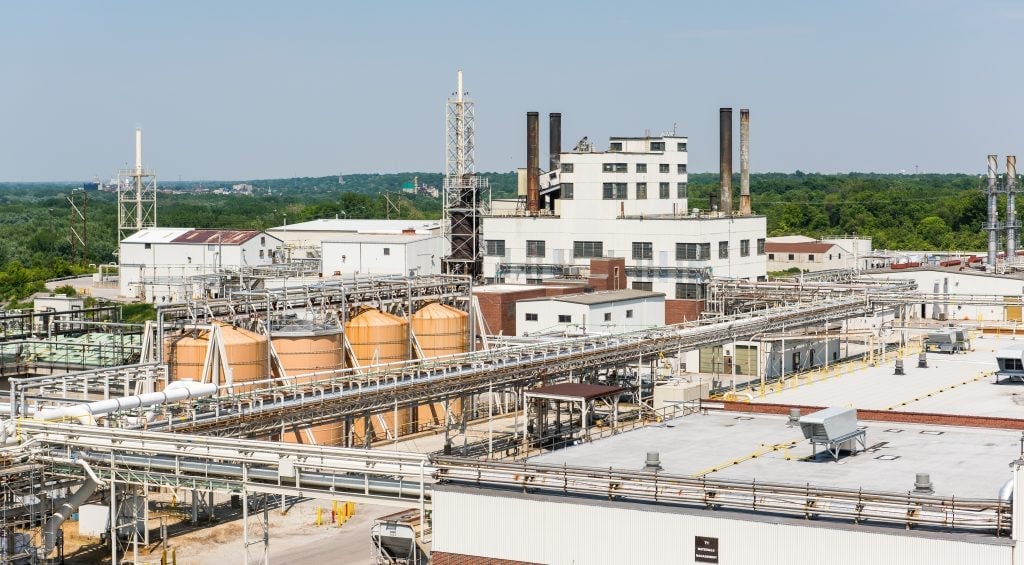
It is made in a reactor, often a very large one, through chemistry that can run to dozens of steps and take weeks. Much of it happens in places that look nothing like a laboratory and everything like a manufacturing facility. One of the largest such places in the world sits in Shadeland, Indiana, on ground that used to belong to Eli Lilly.
This summer, Evonik, the German specialty-chemicals company that now owns the site, said it would spend $100 million over five years to modernize it with new reactors, more automation and better reliability. The investment is a small entry in a very large ledger. Prodded by tariffs and national-security worry, drug companies have announced somewhere between $370 billion and $480 billion in new American manufacturing for the back half of this decade, an attempt to rebuild in a few years an industry the country spent decades shipping abroad.
As recently as 2019, barely more than a quarter of the facilities registered to make the active ingredients in American medicine sat on American soil, according to Food and Drug Administration (FDA) data; the rest were overseas, much of it in China and India. Even that understates the dependence. The raw chemical building blocks those ingredients are synthesized from, the key starting materials, remain overwhelmingly Chinese, so making the final molecule in Indiana does not entirely cut the cord.
The pandemic exposed how fragile that arrangement was, and Washington has been trying to reverse it since, most bluntly this spring, with a 100% tariff on many imported drugs and the ingredients that go into them, exempting companies already building on American ground. Evonik is building on American ground. But the reshoring wave, in Lafayette as everywhere, keeps hitting the same wall: the equipment is far easier to buy than the people to run it.
It is not the first bet Evonik has made on Lafayette, or the biggest. The company bought the plant from Lilly in 2010 and spent the following decade turning a factory built for a single customer into a contract manufacturer serving more than 20. In 2022 it committed $220 million dollars to a Lipid Innovation Center at the same site — a plant for the fatty nanoparticles that ferry mRNA vaccines into cells — roughly two-thirds of it federal money, a piece of the country’s post-pandemic scramble to make such things at home.
This time the money goes into equipment the plant already runs, modernizing its largest reactors and the systems around them and automating where it can, to keep an established business competitive rather than to start a new one. Evonik calls it “smart preservation.”
The workers are the harder problem. For most of its history the Lafayette plant recruited operators who already had manufacturing behind them; in a business this regulated, experience is efficient. But experience, lately, is scarce and fought over. Greater Lafayette is in the middle of an industrial boom that has less to do with pharmaceuticals than with silicon.
A few miles away, in West Lafayette, the South Korean chipmaker SK hynix is building an advanced semiconductor-packaging plant that will cost something like $4 billion, which is the largest single economic-development project in the state’s history and will need, when it runs, on the order of 1,000 workers.
Tippecanoe County already counts more than 35,000 manufacturing jobs across roughly 177 facilities according to the state’s Department of Workforce Development. Capital, it has been noted, moves faster than labor. A workforce-research firm found recently that metropolitan Indianapolis absorbed hundreds of millions of dollars in advanced-manufacturing investment over two years while its advanced-manufacturing employment barely moved. The plants get built. Filling them is another thing.
“You can’t recruit your way out of a labor shortage this tight; at some point you have to build the workforce yourself, and that’s what Evonik is doing,” said Mikel Berger, president and chief executive of Greater Lafayette Commerce, the region’s primary chamber of commerce and economic development organization. “For years, employers here competed for the same experienced operators. Now someone with a high-school diploma and no manufacturing background can walk into one of the most advanced plants in the world and build a career.”
And so, in December, Evonik’s Lafayette site hired seven people who did not know how to make drugs. The company started a 15-month apprenticeship, the first of its kind at the site, for people with a high-school diploma. They split their days between the production floor and classrooms at Ivy Tech, the community college, where they study the math and chemistry the work requires, and where they shadow experienced operators.
Evonik built the program with Ivy Tech and other local employers, Greater Lafayette Commerce among them. A second class begins in the fall.
The model is an old one lately back in fashion: the registered, earn-and-learn apprenticeship that the U.S. Labor Department and the State of Indiana have been pushing for advanced manufacturing, in which a worker draws a paycheck on the plant floor while a community college handles the classroom half.
The credential at the end — Ivy Tech’s technical certificate in process operations — is a real 34 credit program the state will often fund for nothing through its Next Level Jobs initiative; Evonik has wrapped it inside a paying job. The apprentices earn a full production wage from the first day. Training an operator over 15 months is cheaper than hiring an experienced one away from someone else, and increasingly, there is no experienced one to hire.
The urgency comes partly from the chemistry, which keeps getting harder. The molecules modern medicine wants — drugs for cancers, for metabolic and cardiovascular disease — are larger and more intricate than the ones the industry grew up making, and they demand more of the plant, and of the people, who make them.
“API complexity continues to rise,” Daniel Fricker, who runs Evonik’s drug-substance line, said of the investment; the money, in his telling, is what lets the company keep saying yes to the difficult ones.
API is active pharmaceutical ingredient — one of those pieces of jargon that, once you learn it, you notice holding up everything. A more complicated molecule is not only a chemistry problem. It is a training problem.
“Strengthening our U.S. drug substance business is a strategic necessity,” said Guido Skudlarek, the head of Evonik’s health-care business. “With demand surging, Tippecanoe plays a pivotal role in creating a more resilient and globally balanced asset footprint.”
The company is rebalancing its factories across North America, Europe and Asia, adding fermentation capacity in Slovakia, shedding some older assets in Germany and tilting, deliberately, toward North America; the Lafayette site, Evonik’s second-largest in the United States and by some measures one of the largest active-ingredient operations anywhere, is the pivot of that plan.
Since leaving Lilly’s hands it has grown into a multi-customer operation running the industry’s largest high-potency line, hundreds of cubic meters of reactor capacity, thousands more for fermentation and a portfolio of technologies. It makes the hard parts of other companies’ medicine, and now it is being asked to make harder parts, faster and more of them.
There is a symmetry to the two commitments, the capital and the labor, arriving together: $100 million to modernize the machines, a handful of apprentices to run them. The first is the kind of decision a company can make in a quarter, and has made, at this site, more than once.
The second is slower, and less certain, and in some ways more revealing: an admission that the thing standing between American ambition and American manufacturing is not, in the end, money or even demand, but the work of teaching people how to do the work. Seven at a time, in Lafayette, Evonik has begun.