GREATER LAFAYETTE TAKES ITS CASE TO WASHINGTON AS SEMICONDUCTOR INVESTMENT ACCELERATES
Regional leaders warn workforce, housing and infrasturcture pressures could determine whether federal economic investment succeeds
By Shelby White | May 22, 2026
The federal government has already committed hundreds of millions of dollars to one of the largest economic development projects in Indiana history. This week, leaders from Greater Lafayette traveled to Washington to argue that what happens next may matter just as much as the original investment itself.
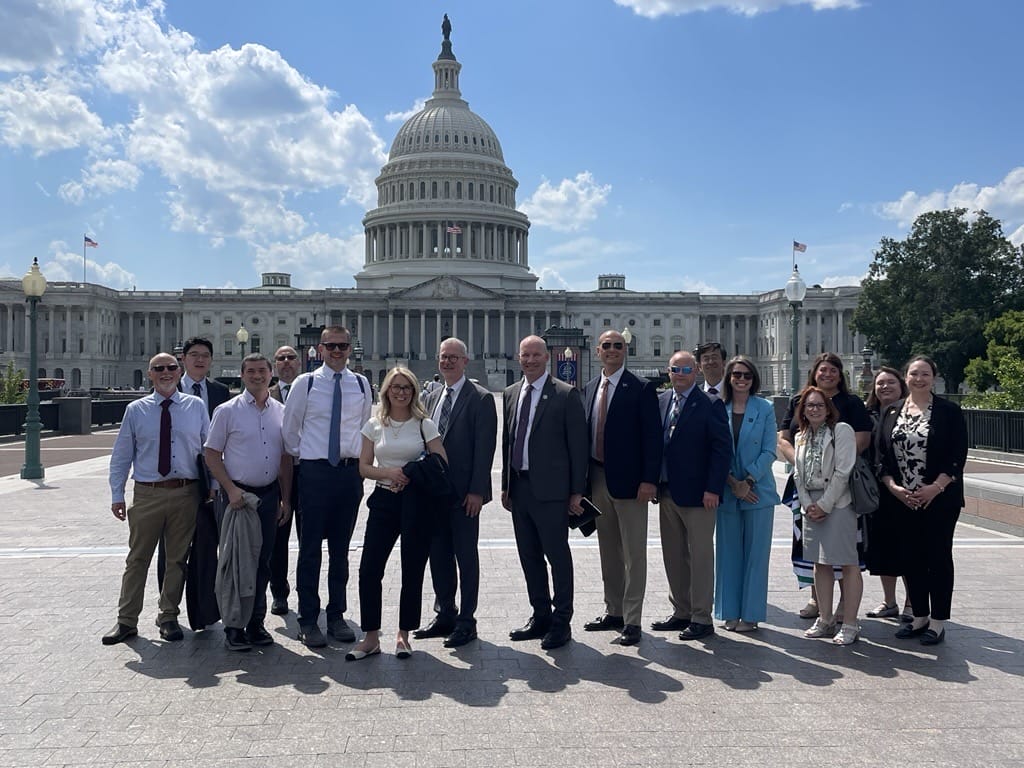
Over three days of meetings on Capitol Hill and at the U.S. Chamber of Commerce, nearly 30 representatives from Greater Lafayette Commerce — the region’s leading chamber of commerce and economic development organization — met with Indiana’s congressional delegation to deliver a focused message: the region’s semiconductor expansion is underway, but workforce shortages, housing supply and infrastructure capacity could determine whether the investment reaches its full potential.
The delegation included mayors from five communities, executives from SK hynix and Subaru of Indiana Automotive, leaders from Purdue University and Ivy Tech Community College, transportation officials, health care administrators and regional manufacturers.
At the center of the discussion was SK hynix’s planned $3.87 billion advanced chip packaging facility in West Lafayette, which received $458 million in CHIPS and Science Act funding from the U.S. Department of Commerce. Production at the facility is expected to begin in 2028.
“We’re here to make sure the investment already happening in this region has the workforce, infrastructure and policy support needed to succeed long term,” said Mikel Berger, president and CEO of Greater Lafayette Commerce.
A national strategy meets local realities
The trip comes at a pivotal moment for the semiconductor industry and the future of the CHIPS and Science Act, which Congress passed in 2022 to strengthen domestic manufacturing and reduce U.S. dependence on overseas chip production.
But communities across the country have discovered that landing a semiconductor facility is only the beginning. The larger challenge often comes afterward: building enough housing, transportation systems and skilled labor capacity to absorb rapid growth.
Greater Lafayette leaders repeatedly pointed to central Ohio, where Intel’s planned manufacturing expansion triggered immediate concerns over housing shortages, school enrollment growth and workforce readiness. Intel’s project has since faced delays amid changing market conditions and corporate restructuring.
Regional officials say Greater Lafayette faces many of the same pressures, even if on a smaller scale.
Federal estimates project the U.S. semiconductor industry will need roughly 90,000 additional skilled technicians by 2030, along with more than 100,000 construction workers needed to build new facilities nationwide.
For a region of roughly 230,000 residents, those national labor demands quickly become local questions about where new workers will live, whether roads and transit systems can handle additional growth and how quickly workforce training programs can expand.
Purdue University has already begun developing semiconductor-focused curriculum and workforce programs alongside SK hynix and Ivy Tech Community College. The university also reported approximately $1 billion in annual research expenditures in fiscal year 2025, placing it among the nation’s leading research institutions without a medical school.
Still, researchers studying implementation of the CHIPS Act have noted that midsize regions often face steeper challenges scaling housing, transportation and quality-of-life infrastructure than larger metropolitan areas with more established systems already in place.
The policy conversation
While delegation members emphasized they were not seeking additional direct subsidies, several themes surfaced repeatedly during meetings in Washington, including workforce development support, infrastructure investment tied to industrial growth and long-term policy predictability for manufacturers making multibillion-dollar commitments.
Those conversations took different forms depending on the audience.
Meetings with Sen. Todd Young focused heavily on national security and domestic semiconductor production. Young co-authored the CHIPS and Science Act and has publicly supported the SK hynix project since its announcement.
Discussions with Sen. Jim Banks centered more directly on workforce preparation and labor pipeline development through the Senate Health, Education, Labor and Pensions Committee.
The delegation also met with Rep. Jim Baird and senior staff from the offices of Reps. Jefferson Shreve and Rudy Yakym.
A manufacturing region preparing for growth
Local officials argued that Greater Lafayette enters the semiconductor expansion from a stronger position than many peer communities because of its existing industrial base.
The region already supports more than 35,000 manufacturing jobs across approximately 177 establishments in Tippecanoe County, according to the Indiana Department of Workforce Development.
That base includes Subaru of Indiana Automotive, Wabash, Caterpillar, GE Aerospace, Rolls-Royce, Saab and Arconic.
Still, regional employers say uncertainty surrounding tariffs, permitting timelines and supply chain disruptions continues to shape long-term planning decisions.
Transportation and health care leaders joined the delegation to underscore that economic growth requires more than factory construction alone. Bryan Smith of CityBus focused on regional mobility and commuter access, while Franciscan Health’s Lisa Decker represented concerns about health care capacity in a rapidly growing labor market.
One of the delegation’s central messages was that the economic effects of the SK hynix project will extend well beyond Lafayette and West Lafayette.
Mayors and local officials from Crawfordsville, Delphi, Monticello and surrounding communities joined the trip to emphasize that housing demand, workforce migration and infrastructure strain will ripple across the broader nine-county region.
That regional framing has become increasingly important as local governments attempt to coordinate housing development, workforce training and transportation planning ahead of the facility’s expected opening.
Whether those systems can scale quickly enough remains an open question.
For now, regional leaders say the immediate goal was visibility.
“The point was to be in the room,” Berger said. “To put faces and a regional story behind the policy conversations that will shape, in ways both direct and indirect, whether Greater Lafayette’s moment becomes a model for what midsize American cities can do with the right investment and the right attention from Washington.”