VILLAGE CAREGIVING OPENS IN LAFAYETTE, OFFERING FAMILIES — AND EMPLOYERS — SOME RELIEF
Village Caregiving opens in Lafayette, offering families — and employers — some relief
By Shelby White | Photos by Jennifer Boss | May 28, 2026
Around 5:30 each morning, before the workday begins, thousands of Hoosiers are already working a second shift. They are helping aging parents out of bed. Measuring medications into paper cups. Calling insurance companies from parked cars before clocking in. The labor is intimate, repetitive, and it mostly goes under the radar, until it begins to interfere with everything else.
 The Baby Boom generation is now well into its 70s. As roughly 73 million Americans age into the years when daily life requires more help, the demand for care — paid and unpaid — is accelerating faster than the system built to provide it can absorb.
In Indiana, roughly 1.2 million residents serve as caregivers for a family member or loved one, according to AARP. Nearly two-thirds also hold jobs. Some eventually cut back their hours. Others leave the workforce. Together, they provide an estimated $10.8 billion in unpaid care annually, propping up a long-term-care system increasingly unable to meet demand on its own.
That reality has turned caregiving into more than a private family concern. In communities like Greater Lafayette, it is becoming an economic one.
Village Caregiving is among the companies moving to meet it. The West Virginia-based company, which provides nonmedical in-home assistance for seniors, opened May 20 in downtown Lafayette at 300 Main St., Suite 310. Headquartered in Barboursville and founded in 2013, it has since expanded to roughly 70 locations across 22 states, primarily throughout the Midwest and Appalachian regions.
The company sends caregivers into clients' homes to help with meals, bathing, getting around and basic transportation, the kinds of daily tasks that often determine whether someone can stay in their own house or ends up in a facility.
Village Caregiving’s growth reflects broader trends reshaping the senior-care industry, where demand for home-based services continues climbing as the population ages and families look for alternatives to nursing homes and assisted living facilities. Industry analysts project continued expansion in the home-care sector over the next decade, driven by labor shortages in institutional care settings and increasing consumer preference for aging in place.
The opening arrives at a moment when Indiana’s caregiving infrastructure is under growing strain. Between 2018 and 2022, the state’s home-health workforce declined by 15%, even as demand accelerated. Last year, nearly 8,000 Hoosiers remained on waitlistsfor home- and community-based services. For employers, the consequences increasingly show up not only in health-care costs, but in staffing shortages, absenteeism and burnout among workers balancing jobs with caregiving responsibilities.
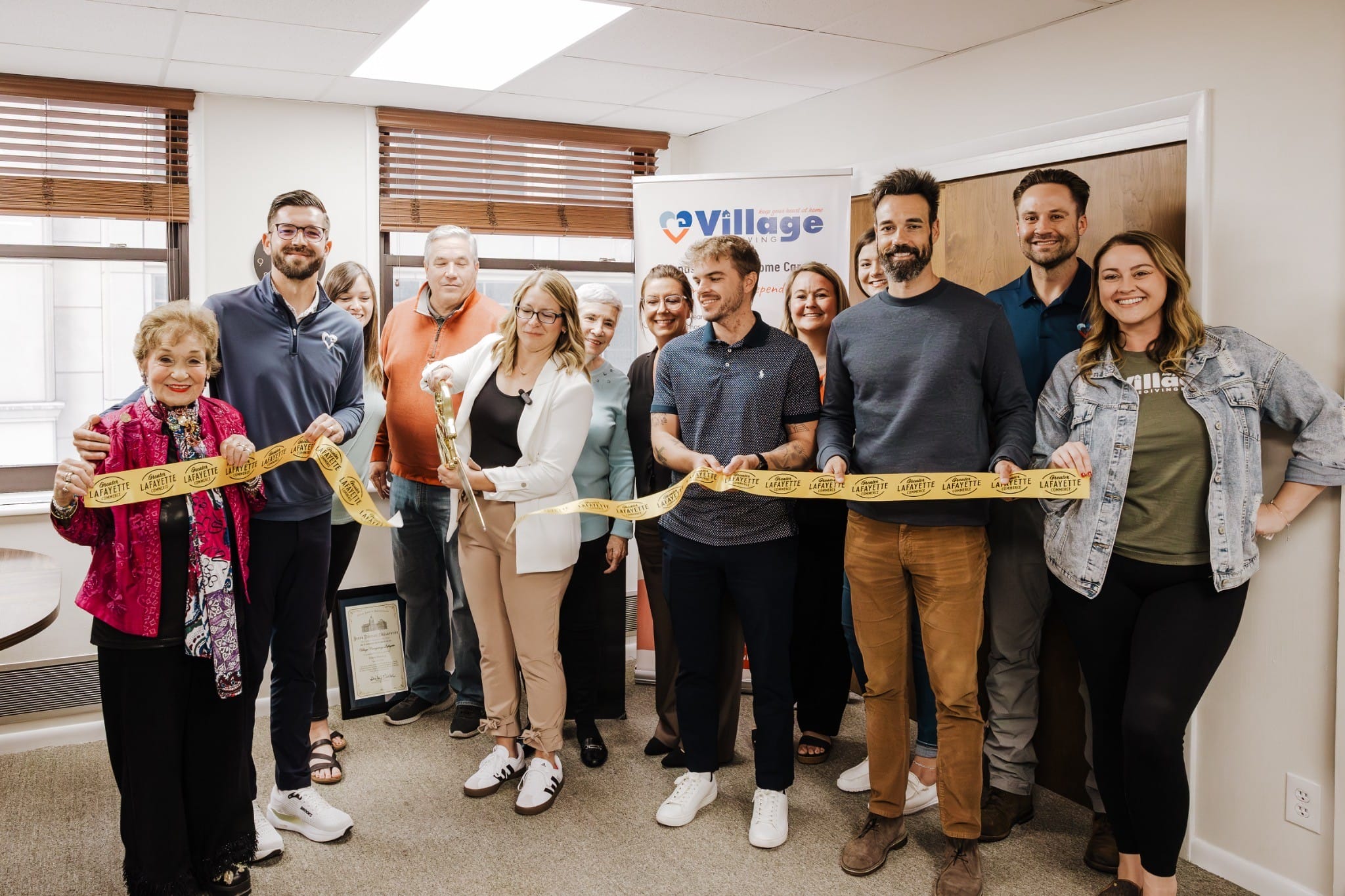
The Lafayette office, led by executive director Jocelyn McCombs, opened quietly in fall 2025 and already employs 29 caregivers serving 27 clients across nine counties in north central Indiana, including 16 military veterans.
Before joining Village Caregiving, McCombs worked as a certified nursing assistant in long-term care facilities before moving into health care administration. She said years spent inside institutional care settings left her increasingly disillusioned by how often seniors and families were forced to navigate an overwhelmed system with too few resources and too little time.
“I loved working with the elderly, but over time I became burned out watching so many people fall through the cracks,” McCombs said during Wednesday’s ribbon-cutting ceremony. “When I had the opportunity to move into home care, it completely changed my perspective. It reopened my heart to senior care and reminded me of the difference compassionate, personal care can truly make in someone’s life.”
McCombs, who grew up in the region, said the work feels deeply personal because many of the people seeking help are not strangers, but neighbors, veterans and local families trying to keep loved ones safely at home while balancing careers and children of their own.
“Being able to help seniors remain safely and comfortably in their homes while still feeling seen, respected and cared for is incredibly important to me,” she said. “When we talk about serving seniors in this community, we’re talking about our parents and grandparents.”
The region already has a crowded field of providers. Home Instead has operated in Lafayette since 2006, alongside companies such as Comfort Keepers, Senior Helpers, Cornerstone Caregiving and Homecare By Design. But demographic trends continue to reshape the market. Indiana’s population is aging rapidly, while the supply of professional caregivers remains unstable, in part because of low wages and high turnover throughout the industry.
For Greater Lafayette Commerce, the region’s primary chamber of commerce and economic development organization, the issue increasingly overlaps with workforce development.
“Most of us have been there, or we will be,” said Brittany Matthews, director of operations and events at Greater Lafayette Commerce, which represents more than 1,000 businesses in the region. “A parent who needs a little more help. A grandparent who wants to stay in their house but can’t manage it alone. It’s one of those things families figure out as they go, and it’s not always easy to know where to turn.”
She said reliable in-home care can have ripple effects well beyond the household itself.
“When families have support they trust, it changes everything,” Matthews said. “People are better able to stay present at work, keep their routines stable and avoid reaching that crisis point.”
In Indiana, where workforce participation remains a persistent concern among employers, caregiving is increasingly viewed not solely as a health-care issue, but as a hidden force influencing economic stability.
Most families, however, encounter it not as a policy debate, but gradually and personally, one interrupted workday at a time.