SMALL BUSINESSES POURED MORE INTO MARKETING IN 2026. MANY STILL DON’T KNOW WHETHER IT WORKS
Main Street is outspending its uncertainty. Small businesses are boosting posts and buying leads while tariffs eat their margin and most of them still can't trace a dollar spent
By Shelby White and Jennifer Boss | May 26, 2026
There is a particular kind of frustration that belongs almost exclusively to small business owners. The product is good. The customers who find it tend to come back. The problem is that not enough people are finding it, and every solution the market offers seems to cost more than the problem itself.
 That frustration is not unfounded. Marketing is the top operational challenge for small businesses, cited by 37% of established owners as their biggest hurdle, according to the 2025 Shopify Merchant Survey. The marketing industry has grown up around that pain point, and it has a financial interest in making the solution feel more complicated, and more expensive, than it is.
So small businesses spent more. In 2026, 68% increased their marketing budgets, meeting economic pressure and rising costs with aggression rather than retraction, according to the Q1 2026 Small Business Now Report from Constant Contact. On Main Street in Lafayette, on Columbia Street, in strip plazas in West Lafayette, the instinct is the same everywhere: if customers are pulling back, you push forward. You get visible. You spend.
Most of them are still waiting to find out if it worked.
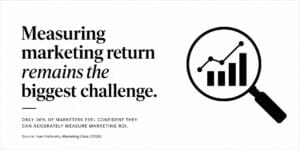
Only 36% of marketers feel confident they can accurately measure marketing return on investment, and nearly half — 47% — struggle to track performance across multiple channels, according to 2026 data compiled by marketing analyst Ivan Vislavskiy. Forty-four percent of small business owners name customer engagement as their single biggest marketing barrier, meaning that as budgets climb, actual connection with customers is not keeping pace, according to a 2026 report from DIY Marketers citing Constant Contact research.
The Greater Lafayette region enters 2026 with softening wages, lackluster job creation, stubborn inflation and trade policy uncertainty layered underneath all of it, according to Indiana University Southeast economist Uric Dufrene writing in InContext: Indiana’s Economy. The regional picture mirrors the national one, only with less margin for error. A restaurant on South Street does not have the cushion a regional chain has. A contractor working Tippecanoe County does not have a corporate marketing department running attribution models. They have a phone, a Facebook page and a finite number of hours in the day.
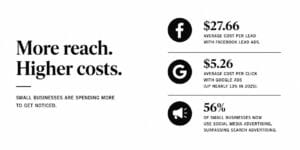
Into that reality, the platforms have sold a particular promise: reach. Boosted posts. Sponsored listings. Lead generation campaigns priced low enough to feel manageable and opaque enough to feel like progress. Social media advertising now reaches 56% of small businesses, surpassing search advertising — a shift driven in part by the perception of lower cost, according to research from PPC Landpublished in November 2025. The perception does not always survive contact with the invoice. Facebook Lead Ads average $27.66 per lead. Google Ads cost $5.26 per click across industries, a figure that rose nearly 13% in 2025 alone.
The platforms are not neutral parties in this transaction. Their incentives are not aligned with yours. A boosted post generates impressions. Impressions generate a report. The report shows numbers going up. Whether any of those numbers correspond to a customer who actually walked through the door is a question the platform has little structural interest in helping you answer. Marketing reports tend to focus on what is easiest to measure rather than what is most meaningful, according to Wabash and Lake Consulting’s 2026 analysis of small business marketing ROI. Website traffic, impressions, social engagement, follower growth — all of it can indicate visibility. Visibility alone does not pay the bills. 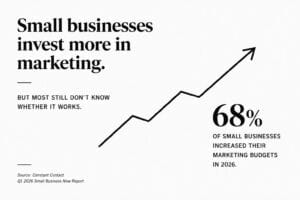
Marketing strategists and small business researchers return consistently to three questions as the baseline diagnostic. Where did my new customers come from. What did it cost to get them. What are they worth over time.
Most small business owners cannot answer all three. Many cannot answer any of them with confidence. That is not because they are bad at business. It is because they never set up a way to find out. They boosted the post, sent the email, ran the ad and then moved on to the next thing without ever asking whether any of it brought someone through the door.
In fact, 73% of small business owners say they lack confidence in their marketing strategies, according to a 2026 analysis by RevenueMemo drawing on data from the U.S. Small Business Administration, HubSpot and industry surveys. That figure is not surprising once you understand that most of them are making decisions without knowing what their last round produced. The uncertainty is the predictable result of a system designed to sell advertising, not to help small businesses understand whether they need it.
The businesses that answer those three questions consistently — even imperfectly, even with a spreadsheet and a best guess — tend to outperform the ones spending twice as much without any feedback loop in place. They know which channel is generating customers, not just clicks. They can calculate whether $300 a month in ad spend is producing $300 worth of new business. They understand that a customer who returns four times is worth more than the promotion it took to bring her in the first time. That kind of clarity is not a function of budget. It is a function of asking.
The channels with the strongest documented return tend to cost the least to start, and most businesses have not fully built them yet. The Google Business Profile — the information panel that surfaces when someone searches for a category near them — is the one most commonly claimed and most commonly neglected. According to a 2026 optimization analysis by Directory One, verified profiles with complete information are 80% more likely to appear in search results.
Profiles with photos uploaded in the last 30 days receive 35% more clicks than those with older imagery, according to research published by digital marketing firm 20 Minute Marketing. The businesses that treat it as a publishing platform — posting weekly updates, responding to every review, adding current photos — tend to outrank competitors in local search results regardless of how much those competitors are spending on advertising. It costs nothing, and it takes about 20 minutes a week.
Search engine optimization carries an awkward reputation among small business owners: too technical, too slow, too dependent on specialists charging more than most can afford. The reputation is not entirely wrong, but it obscures something important. According to Google data cited in BrightLocal’s 2026 local SEO statistics, 46% of all Google searches carry local intent, meaning nearly half of the billions of daily searches are looking for something nearby. Seventy-six percent of those searches result in a store visit within 24 hours, and 28% end in a same-day purchase, according to Google research compiled by BrightLocal. For a business with a physical address in Lafayette, that is not an abstract marketing statistic. It is foot traffic already in motion.
The local SEO case rests less on technical complexity than on consistency. According to Ahrefs data cited in BrightLocal’s 2026 report, only 36% of small businesses invest in SEO at all, which means less competition for the businesses that do. The basics are not complicated: a complete Google Business Profile, a website that loads cleanly on a phone, a handful of pages that answer the questions customers are already typing into search. First Page Sage’s 2026 research finds that local SEO generates an average return of over 300% within three years, and unlike a paid ad, a page that ranks keeps working after the budget runs out.
Social media is where most small business owners are already spending time, and where most of them are doing the least effective work. The problem is rarely the platform. It is the approach. Ninety-one percent of small businesses use social media for marketing, according to research from PPC Chief, which means the question is no longer whether to show up. It is whether businesses are showing up in a way that does anything.
The failure mode is familiar: sporadic posting, promotional content, no clear sense of who the audience is or what they need to hear. Businesses spread thin across four or five platforms, producing content that leads with the business rather than the customer. The platforms are not interchangeable, and treating them as such wastes time that small business owners do not have. A business that sells visual products — food, clothing, handmade goods — has a natural home on Instagram and TikTok. A service business targeting professionals will find more traction on Facebook or LinkedIn. According to the 2025 Sprout Social Index, 39% of consumers turn to Facebook first when ready to make a purchase, with TikTok close behind at 36% and Instagram at 29%.
What performs consistently well across all of them is not polished production. Research tracking engagement data finds that 63% of consumers say they value authenticity over polish in marketing content, according to the 2025 Sprout Social Index. A contractor explaining what he is seeing inside a wall. A bakery owner talking about where a recipe came from. A bookstore walking customers through what arrived in the last shipment. These posts consistently outperform promotional content, and they cost nothing to produce beyond the time it takes to film them.
The content framework that practitioners return to: teach something useful in your field, show the real work, highlight your customers. Keep promotional content under 20% of what you post. Pick one or two platforms and commit to them. Use social to capture attention, and then give people somewhere to go. A link to sign up for the email list. A prompt to leave a Google review. Social media builds an audience. The owned channels are what convert it.
 Email is the other channel the data keeps returning to, and the one with the most durable case behind it. Email generates between $36 and $40 for every dollar spent, compared to an average return of $2 to $5 for social media ads, according to a 2026 email marketing analysis by VaultAI Pro citing benchmarks from InboxAlly and PPC Chief. Unlike social channels — where some publishers have lost up to 80% of their reach overnight to algorithm changes — an email list is a fully owned audience asset, according to Vertical Response’s 2026 review of email marketing trends. No platform can reprice it. No update can cut it in half.
The businesses that use email well tend to start simply: a discount or a small offer at checkout in exchange for an address, followed by a short welcome sequence — an introduction, the origin story, a few customer experiences in plain language. After that, a monthly newsletter with something worth reading. The goal is not volume. It is the habit of showing up in someone’s inbox with something useful, on a channel that belongs entirely to you.
Earned media — coverage in a publication a customer already reads and trusts — is the third lever, and the one most small business owners assume is out of reach. It is not. Local journalists are working more beats with fewer resources than at any point in recent decades. They need credible, articulate sources who can speak to the larger stories they are already assigned to tell. Only 2 to 3% of press releases result in any media coverage at all, according to industry data compiled by SEO Design Chicago citing Cision research.
The ones that do share common traits: they contain genuine news, they are written in journalistic style and they connect the business to something bigger than the business itself. Not “I opened a new salon,” but how a local salon is filling a workforce gap by training teenagers aging out of foster care. Not “I run a bakery,” but how rising ingredient costs are forcing independent bakeries to reinvent their menus. According to Nielsen’s Global Trust in Advertising report, 84% of consumers trust earned media — coverage, word of mouth, editorial mentions — above all other forms of advertising. A published story lives on Google indefinitely. A boosted post does not.
None of these tactics require a large budget. They require consistency, a clear story and a willingness to show up where customers are already looking and to track, even roughly, whether any of it is working. The businesses most likely to come out of 2026 with marketing that works are not the ones spending the most. They are the ones that stopped long enough to ask whether what they were already spending was doing anything.
The floor for effective marketing has always been lower than the industry wants small business owners to believe. The data has said so for years. Most businesses just never had a reason urgent enough to test it. This year might be that reason.