MAY 2026 SMALL BUSINESS OF THE MONTH: LAFAYETTE HEARING CENTER
The business of hearing
By Shelby White | Photos by David Huhnke | May 29, 2026
When Dr. Susan Talia's phone went quiet in late 2022, she paid attention.
 The federal government had just cleared the way for over-the-counter hearing aids to be sold in drugstores and online without a prescription, a regulatory shift that advocates called democratizing and that sent independent audiologists bracing for disruption. At Lafayette Hearing Center, where Taulia had taken over as owner just four years earlier, the silence was palpable.
“The phone stopped ringing for a bit,” she says. “And I was scared.”
It didn’t last. But that moment of quiet sits at the center of a much louder story unfolding across the audiology industry, one that touches on who gets to deliver hearing care, who can afford it and whether a $300 device from a drugstore shelf is any substitute for a clinician who has spent a career learning what the brain does when it stops hearing well.
Taulia has spent the last eight years building Lafayette Hearing Center into a regional practice with five audiologists and a clinical range it didn’t have when she took over. She’s done it in the middle of an industry being pulled in every direction at once by Silicon Valley, by neuroscience, by a consolidating corporate sector and by a patient population that keeps waiting too long and expecting too much from a widget.
The audiology industry doesn’t lack for tailwinds. The global hearing aids market was valued at more than $9 billion in 2025 and is projected to nearly double by 2035, driven by an aging population, rising rates of noise-induced hearing loss and accelerating technology. But the more consequential shift may be scientific.
In 2024, the Lancet Commission on dementia prevention identified hearing loss as the single largest modifiable risk factor for dementia across midlife, larger than high blood pressure, physical inactivity or smoking. A Johns Hopkins study the following year found hearing aid use was associated with a 32% lower prevalence of dementia in people with moderate or severe hearing loss. The research literature, almost in unison, has arrived at a conclusion the profession has been circling for years: hearing health is brain health.
That reframing matters to practitioners like Taulia, who has watched patients delay treatment for years, calculating whether the cost is worth it for what they perceive as a quality-of-life inconvenience. It may be accelerating cognitive decline.
Taulia took over Lafayette Hearing Center from founder Mary Caccavo in 2018. At the time the practice had two full-time audiologists and one working 80%. Today it has five, offering services that didn’t exist there six years ago: cochlear implant programming, auditory processing testing and a specialized tinnitus treatment protocol called Lenire. Her oldest cochlear implant patient was 95. Her youngest is in her 50s. Patients who used to travel to Indianapolis or beyond for implant activation are coming to Lafayette instead.
That growth reflects both deliberate strategy and something harder to manufacture: a willingness to talk plainly about what hearing care involves. Taulia calls it “the dirty secret nobody wants to talk about.”
“People want to think the hearing aid is the magic widget,” she says. “And it often is a big piece of solving the problem. But people don’t get back what they don’t have. Once you’ve lost the structures in your ear that respond to very soft sounds, they don’t come back. The hearing aid is trying to do the job of those structures, and it’s never as good as what you started with.”
What patients often don’t realize is that successful hearing aid use requires relearning — guided practice, sometimes therapy, an adjustment period that can stretch months. Most aren’t told this upfront. Many give up before they see results. This is where the professional relationship matters, and it’s precisely what over-the-counter products can’t replicate.
According to MarkeTrak 2025, the hearing industry’s flagship consumer survey, 90% of traditional hearing aid users received full professional service including evaluation, selection and fitting. Among OTC device users, only 51% received the same. One in five received no professional assistance at all.
The 2022 regulatory change came with genuine promise. For people with mild loss who have avoided treatment because of cost or stigma, an affordable pharmacy option can be a real first step. Taulia doesn’t dismiss that.
“They’re a great way to stick your toe in the water without breaking the bank,” she says.
The problem is that OTC products are designed for an earlier-stage patient, and they’re often adopted by people who have already waited too long. By the time someone who has quietly struggled for a decade wanders into a Walgreens, their hearing loss may have progressed well beyond what a $300 device can address.
“A lot of people who are putting off treating their hearing loss are still putting it off,” she says. “And by the time they need real help, those products aren’t useful anymore anyway.”
The more disruptive development though is Silicon Valley. Apple’s AirPods Pro gained FDA clearance as a hearing aid in 2024. Meta’s Ray-Ban glasses added real-time speech enhancement. Amazon integrated machine-learning dialogue boost into Fire TV for hearing aid users. Tech giants are reshaping the industry. For independent practices, the risk isn’t that these products replace prescription care — they can’t, for most patients. The risk is delay: patients waiting, trying things, waiting more, while the window for easier intervention quietly closes.
Running a private audiology practice has never been uncomplicated. Hearing care remains one of the most poorly covered areas in American healthcare. Most private insurance plans offer limited or no coverage. Medicare has historically excluded hearing aids. Patients are routinely stunned by what they face out of pocket: anywhere from a few hundred dollars for entry-level devices to more than $10,000 for premium fittings.
“It takes people a while to recognize: if I want good care, I actually have to pay for it,” Taulia says.
That reality has pushed some patients toward corporate chains and big-box providers, which have grown aggressively through the industry over the past decade. Taulia has watched that consolidation from a distance and has no interest in it. She was, by her own description, a bad employee — too opinionated, too attuned to the inefficiencies that accumulate inside large organizations.
“I really chafed at having to work for people who were not great managers or leaders,” she says. “I am not a good employee.”
What she is, it turns out, is a capable builder. She arrived at audiology by accident — an undergraduate in North Carolina cycling through majors, who got a $5-an-hour job at a private practice through a church connection and found herself lit up by the science and the work. She spent her early career in large teaching hospitals, always circling back to the idea of owning something. She got there eventually.
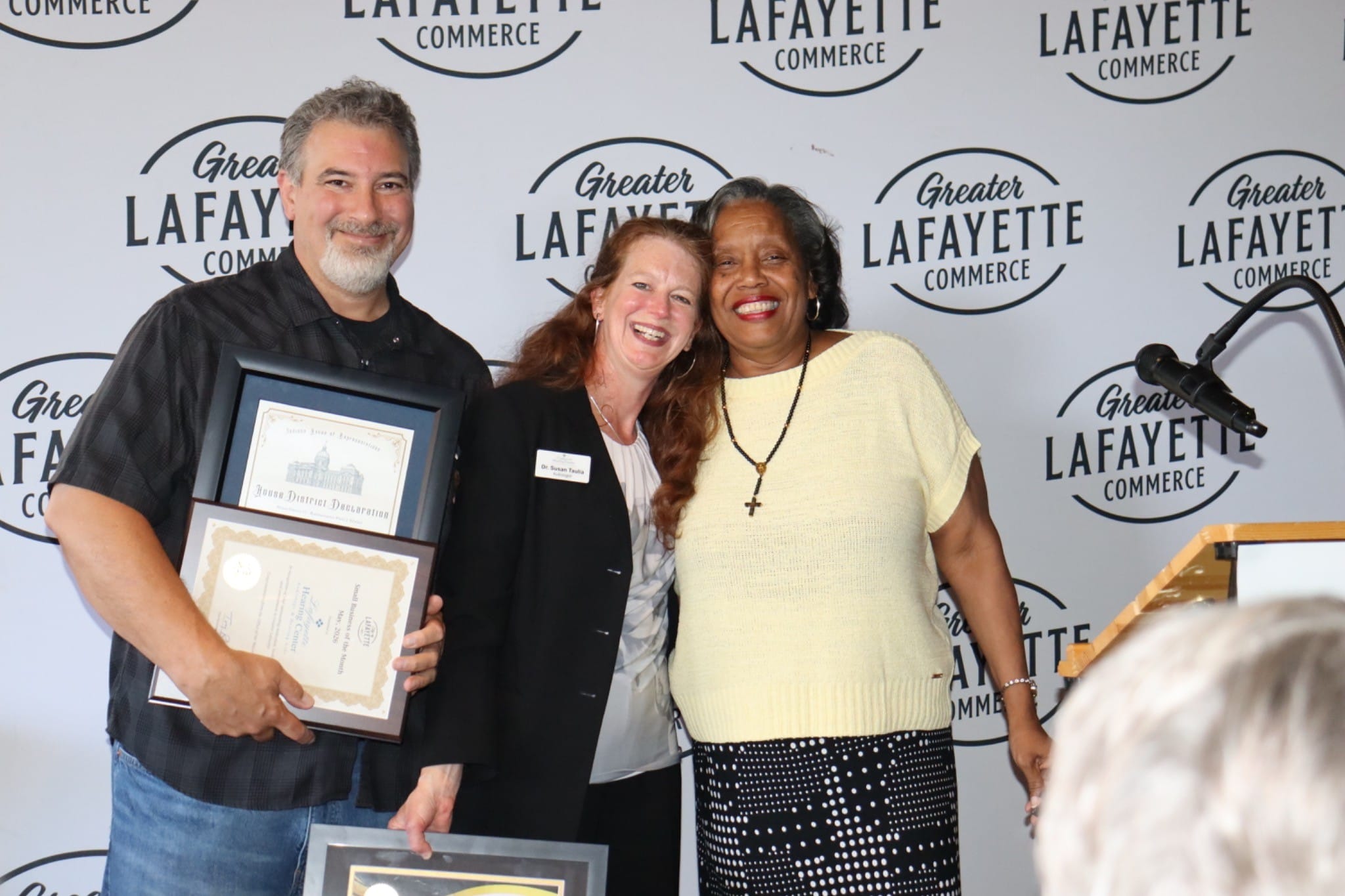
Greater Lafayette Commerce, which named Lafayette Hearing Center its Small Business of the Month for May 2026, sees in Taulia’s practice exactly the kind of business the region needs.
“Lafayette Hearing Center is a great example of what a small business can become when the owner is committed to doing it right,” said Mikel Berger, president and CEO of Greater Lafayette Commerce. “Susan has grown her team, expanded her services, and made sure people in this community don’t have to look elsewhere for the care they need.”
Taulia will tell you the work is hard. The insurance fights, the expectation management, the patients who waited a decade and want results in a week. But she’ll also tell you about the ones who come back. The ones who say it changed their life.
“Not everybody we help is happy,” she says. “But we try really hard to make them all happy. And when somebody comes back in and says you changed my life — I can go for a month on that.”
She’s been chasing that feeling since a $5-an-hour job at a private practice in North Carolina showed her what audiology could look like when someone did it right.
About the Small Business of the Month Program

The Small Business of the Month Program (SBOM) is designed to recognize the dedication, innovation and entrepreneurial spirit displayed by Greater Lafayette Small Businesses. The goal of the monthly award is to highlight a small business and give them extra marketing exposure to aid in growing their business.
The program is sponsored by Old National Bank.