HANDMADE IN THE AGE OF MASS PRODUCTION
At the Historic Lafayette Farmers Market, Mrs. Ginger Handmade reflects a growing appetite for craftsmanship, sustainability
By Molly Welch | May 22, 2026
On Saturday mornings in downtown Lafayette, before the sun has fully burned the coolness out of the pavement, the Historic Lafayette Farmers Market begins assembling itself like a small city.
Trucks back into place. Tent legs snap open against the asphalt. Growers unload crates still damp with early-morning harvests. The scent of breakfast sandwiches and frying bacon wafts down Main Street while somewhere nearby, kettle corn begins popping in gentle bursts, filling the air with butter and sugar. Coffee is already being poured into paper cups by 7:30 a.m.
Then the shoppers arrive.
They move in waves down Fifth Street and along Main — retirees with canvas totes, Purdue students blinking awake behind sunglasses, parents maneuvering strollers around bouquets of peonies and tables stacked with sourdough.
 This year, the market is larger than it has ever been.
With 120 vendors participating in the 2026 season, the Historic Lafayette Farmers Market is experiencing its biggest year in nearly two centuries of operation, a startling level of growth for an institution that began in 1839. Markets like this one are often discussed sentimentally — as quaint holdovers, nostalgic gestures toward simpler economies — but in Lafayette, the farmers market increasingly resembles something more consequential: a functioning local economic ecosystem, one that supports dozens of independent businesses.
For some vendors, the market is supplemental income. For others, it is their main revenue driver.
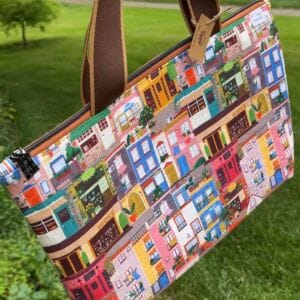
Near the middle of the market, beneath neatly hung rows of patterned fabrics and carefully arranged zipper pouches, sits Mrs. Ginger Handmade, a small business owned by Pia Sirvant, a native of Spain who spent 14 years in Peru before moving to Lafayette. At first glance, the booth feels cheerful and orderly with bright textiles, floral prints, neatly stitched cosmetic bags. But the philosophy behind it is sharp-edged.
“I hate plastics,” Sirvant said.
The sentence lands with the force of something long settled in her mind.
Mrs. Ginger Handmade began during the pandemic, when many Americans found themselves reassessing not only their careers but also their relationship to consumption. Online shopping surged. So did waste. Cheaply manufactured goods, shipped quickly and discarded even faster, became woven deeper into daily life. Sirvant reacted in the opposite direction.
She began sewing reusable fabric goods meant to replace disposable or plastic-heavy alternatives — pouches, bags, organizers, small objects designed not for novelty but for durability.
At the market, customers run their hands across thick cotton fabrics sourced from around the world. The zippers are color-matched. Interior linings are coordinated with unusual precision.
“All of the fabrics I use are OEKO-TEX Standard 100 certified. They have been independently tested to be free from over 1,000 harmful chemicals and toxic substances,” said Sirvant.
Even the smallest pouch carries evidence of deliberation. This level of intentionality has become increasingly valuable currency at farmers markets nationwide, where consumers are no longer simply shopping for produce but for proximity — proximity to the people making their bread, growing their vegetables, sewing their bags.
That appeal has economic consequences.
Farmers markets now function as launchpads for thousands of small businesses that would struggle to absorb the overhead costs of traditional retail storefronts. A booth fee and a folding table are, for many makers, a far more accessible entry point into entrepreneurship than commercial rent. The Historic Lafayette Farmers Market, particularly in its record-setting season, has become one of the city’s most visible concentrations of independent economic activity.
And unlike national retail chains, the money largely stays here.
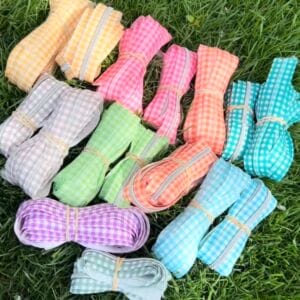 A customer buying a “zippie” from Mrs. Ginger Handmade is not feeding a distant logistics network or a multinational platform economy. They are paying directly for labor, material and design created by someone living, working and investing in the community.
Sirvant’s most popular items are the simplest ones. The “zippies” — compact fabric pouches designed to hold phones, chargers, cosmetics, cash — sell steadily because they solve small daily problems elegantly. Cosmetic bags remain favorites as well. Seasonal collections rotate throughout the year: Halloween fabrics in September, Christmas décor and handmade textile gifts later in the fall.
None of it is mass-produced. That is the point.
By noon, the market begins its gradual unwinding. Vendors pack up. Children trail sticky fingers through the crowd clutching kettle corn. The city blocks slowly reopen to traffic.
For a few hours every Saturday, though, the city belongs to growers, bakers, artists and makers — people still trying to build something with their own hands.