KARA WEBB AND THE FORMULA FOR BUILDING A WORKFORCE
Kara Webb and the formula for building a workforce
How collaboration and grit built one of Indiana’s most effective talent ecosystems
By Shelby White | Greater Lafayette Commerce
Published Oct. 30, 2025

On a crisp Autumn morning at her downtown Lafayette office, Kara Webb is moving fast. She’s at her desk, laptop open, tea cooling.
Her short blonde hair, streaked in whatever color matches her current mood — some days it’s electric blue, others its magenta — has become something of a calling card. But her real mark is harder to miss: the foundries across nine Indiana counties now filling positions they couldn't a decade ago.
“People probably think I’m bold or a little crazy,” she says. “Maybe both. But I think people want to hang out with the crazy.”
The Illinois native-turned-Hoosier is easy to laugh and quick-witted with a knack for remembering something about everyone: a child’s name, a hometown, a favorite baseball team, especially if it’s the St. Louis Cardinals. Her charisma disarms people, but make no mistake: it’s matched by grit, the kind that gets things done.
“I never leave a room without getting to know someone. If I can find one thing we connect on,” she says, “that’s where trust starts.”
It’s a social fluency that seems more natural than strategic, but that mix of warmth and edge has made Kara one of the most influential figures in Indiana’s workforce circle.
For the past 10 years she has been the director of workforce development at Greater Lafayette Commerce (GLC), where she helped design Career+ Pathways, one of the most comprehensive talent pipelines in the state.
The program is a product of a coalition Kara manages, which includes: Ivy Tech Community College, the state’s largest workforce training provider; Purdue University, the region’s research arm; Skyepack, a West Lafayette education technology company; the Region 4 Workforce Board, a public agency that oversees workforce strategy across nine counties; and the Wabash Valley Education Center, which supports professional development for K-12 educators.
Career+ Pathways has attracted nearly $10 million in grants over five years and now spans nine counties and 12 school corporations, reaching tens of thousands of students and serving as a testbed for what’s possible statewide.
A model arriving before the mandate
Career+ Pathways has become one of Indiana’s benchmarks for how education and industry can operate on the same track. While other regions are gearing up to meet the state’s new high school graduation standards, Greater Lafayette is already there.
Approved in late 2024, the policy replaces traditional diploma requirements with a single credential built around “readiness seals” tied to real-world experience and demonstrated employability skills. It’s called Graduation Pathways, and it will take effect with the Class of 2029.
Career+ Pathways has been doing that work for years, embedding work-based learning into the school day, connecting students to employers and giving them credentials that lead directly to jobs or post-secondary training.
The latest data, released this fall, show more than 4,000 students earned microcredentials in 2024–25. Another 61,500 career-connected experiences such as site tours, virtual interviews and micro-internships were logged, and students completed 7,020 hours of work-based learning, with projections exceeding 190,000 hours annually by next year.
The results signal a breakthrough moment for a region that’s long been defined by what it makes and moves.
Manufacturing contributes nearly $120 billion to Indiana’s gross domestic product (GDP) and accounts for 17.4% of its workforce, nearly double the national average. Logistics employs 280,000 Hoosiers and contributes $20 billion to GDP.
But many of those positions are among the hardest to fill, the jobs that demand technical skill and time to train.
That’s the problem Kara has been solving in real time. “You can’t build a pipeline if everyone’s building their own pipe,” she says. “You have to get people in the same room and not leave until you’ve got something that works for all of them.”
The billion-dollar question
That’s exactly what Kara did when Evonik Industries, a specialty chemicals company with a plant in Lafayette, came to her in 2024, facing a familiar problem playing out in Indiana: too few trained workers, and too long a training timeline.
To find a solution, she gathered the employers that rely on the same workforce — Evonik, Primient, Tate & Lyle and Cargill, companies that anchor the region’s chemical and food-processing sector — along with Ivy Tech Community College and the Region 4 Workforce Board.
The question Kara posed was simple: What does a great chemical operator need to know, and when should they learn it?
The answer reshaped how the region trains its workforce. The group found that the best place to start wasn’t inside the plant; it was in high school. Together, they designed a training program around the demands of the job itself, one that introduces students to the fundamentals of chemical operations before they ever clock in.
The 25-hour virtual micro-internship covers safety systems, process flow and plant operations, giving students a credential that stacks directly into Ivy Tech’s chemical operations “earn and learn” program, where students work three days a week on-site and study two days toward an associate degree.
“We had to go through a lot of work to get to this point,” Kara says. “But now it’s replicable. If it works for manufacturing, it can work for healthcare, it can work for semiconductors.”
She’ll need it to. The demand for skilled workers is about to surge again. SK Hynix, a Korean-based leader in the semiconductor industry, is investing $4 billion in an advanced microchip packaging and R&D facility in West Lafayette. The project will bring over 1,000 highly technical jobs to the region. The facility will need a trained local workforce that can step in on day one, the kind of homegrown talent Career+ is designed to develop.
It's part of a larger trend in Indiana’s economy. Since 2021, the state has attracted more than $30 billion in new manufacturing investment, much of it driven by the Creating Helpful Incentives to Produce Semiconductors (CHIPS) and Science Act and the push to build a "Silicon Heartland" in the Midwest.
Every announcement creates the same challenge: jobs arriving faster than workers can be trained. Kara’s approach may be one way can keep up.
From the unemployment line to pipeline design
The heavy metal music Kara listens to seems to keep her alert to the scale of what she’s managing. She draws a connection between the music and her work.
“That’s what this feels like when it’s going right: organized, loud and moving together.”
She’s short in stature, but her heels usually make up the difference. She is one of the few women leading at this level in an industry still dominated by men.
“You have to be tough,” she says. “This job is part diplomacy, part logistics, part survival.” But toughness, for her, is persistence. “In workforce development, you hear ‘no’ a lot,” she says. “You just have to outlast it.”
Kara’s path into workforce development began in the unemployment line. She had just been laid off from an insurance job and went to the local WorkOne office to file her claim. “I remember thinking, what the hell am I going to do?” she says.
The woman processing her claim turned out to be someone Kara knew. “She was a fellow Girl Scout mom,” Kara says.
That connection turned into an opportunity that changed the course of her life. A short time later, WorkOne’s regional manager called with an offer: a temporary position helping process unemployment claims.
Soon, Kara was back in the same office, but this time she was sitting on the other side of the desk, helping newly laid-off workers figure out what came next.
Within months, she had a full-time role helping people retrain for new jobs. From there, she went on to design high-volume assessment centers for Subaru of Indiana Automotive during one of its largest hiring waves. The project screened more than 5,000 candidates.
She learned quickly that jobseekers and employers speak different languages. “I wanted to make the translation,” she says. “And I wanted to fix what was broken.”
That front-row seat to both sides of the labor market shaped the philosophy she still works by.
“Talent pipelines only work when the right people are in the room,” she says, “and when training matches what the job really demands.”
Connecting the dots
At Greater Lafayette Commerce, Kara finally had the latitude to build around that idea.
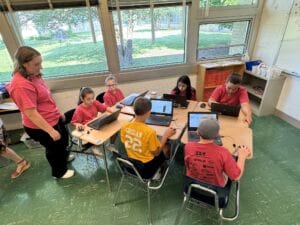 The effort started small with factory tours, Manufacturing Week events and career fairs, the kinds of things that make kids curious about what’s available in their own backyard. But as more schools and employers joined in, those one-off programs started to link together, forming what is now known as Career+ Pathways.
It’s built to follow a student from early exposure to employment, and it begins in elementary school, where programs like Robotics in Manufacturing Camp and Manufacturing Week introduce children to modern industry. “We’ve got second graders who can name the parts of a robotic arm,” Kara says. “That’s the point: make it normal, make it fun.”
By middle school, those glimpses evolve into structure. More than 2,500 students in grades 6–8 now participate annually in discovery workshops and expos. In eighth grade, students complete career interest assessments that feed directly into their high school course work. “It’s about giving them information early enough to make choices that count,” Kara says.
In ninth and tenth grades, students earn microcredentials, digital badges that verify skills like teamwork, communication and time management. The workplace communication credential, for instance, reached 865 students last year.
By their junior and senior years, students shift from exploration to experience: job shadows, employer-led boot camps and micro-internships.
That work comes into sharper focus each spring at HireMe!, a regional interviewing fair where the abstractions of “career readiness” turn into conversations about jobs, pay and next steps. Students arrive with résumés. Employers arrive with open roles. At last year’s fair, 500 high school students sat for 1,300 one-on-one interviews with local companies.
The long game
For employers, the payoff isn’t just a stronger pipeline. The state’s average cost per hire hovers around, according to the Society for Human Resource Management and is often far higher for technical roles where training costs are steep. Career+ Pathways participants, many of whom transition directly into paid positions, cut that cost dramatically.
“The economics of hiring favor early pipelines,” Kara says. “If we can connect students to real work before they graduate, we save employers money and give students a path that’s real.”
The program also gives schools a clearer picture of student progress. Career+ Pathways provides schools with compliance-ready data for Indiana’s Graduation Pathways, documenting work-based learning hours, credentials and employability skills. Workforce boards use the same data to track regional performance metrics.
The platform that holds it all together comes from Skyepack and includes career chats, site tours, credentials and internships, while employers post opportunities. A dashboard of student progress is available, so everyone is working from the same ledger.
“We’re playing a long game,” Kara says. “It takes three or four years before people say, ‘Oh, I’ve heard of that.’ But now we’re hitting our stride.” 
Even with Career+ Pathways showing measurable results, she’s thinking about what comes next.
She wants funding for transportation so more students can reach employers, flexibility for companies to host those under the age of 18 and microcredentials that count toward college credit statewide. And she wants more women in the field.
“We’re building something that should last. I don’t want to fail our employers,” she says. “But I also don’t want to fail the people in this community. I want them to have choices — to see a path.”